Maps drawn for the horse
The body maps, the hoof schema and the point canon follow equine anatomy. Small animals are coming in the near future.
Traditional Chinese Veterinary Medicine
Tongue, pulse, palpation, five element — the whole exam recorded in one structured case file. A hands-free voice assistant fills the fields while both your hands stay on the horse, and optional AI suggestions offer a second read to check against your own.
How it works
One case file that travels with you — phone in the barn, browser at the desk — and assembles the clinical picture while you examine.
Start it on the phone, in the barn or in the browser at your desk — it's the same live case either way. It installs to the home screen and opens with no signal.
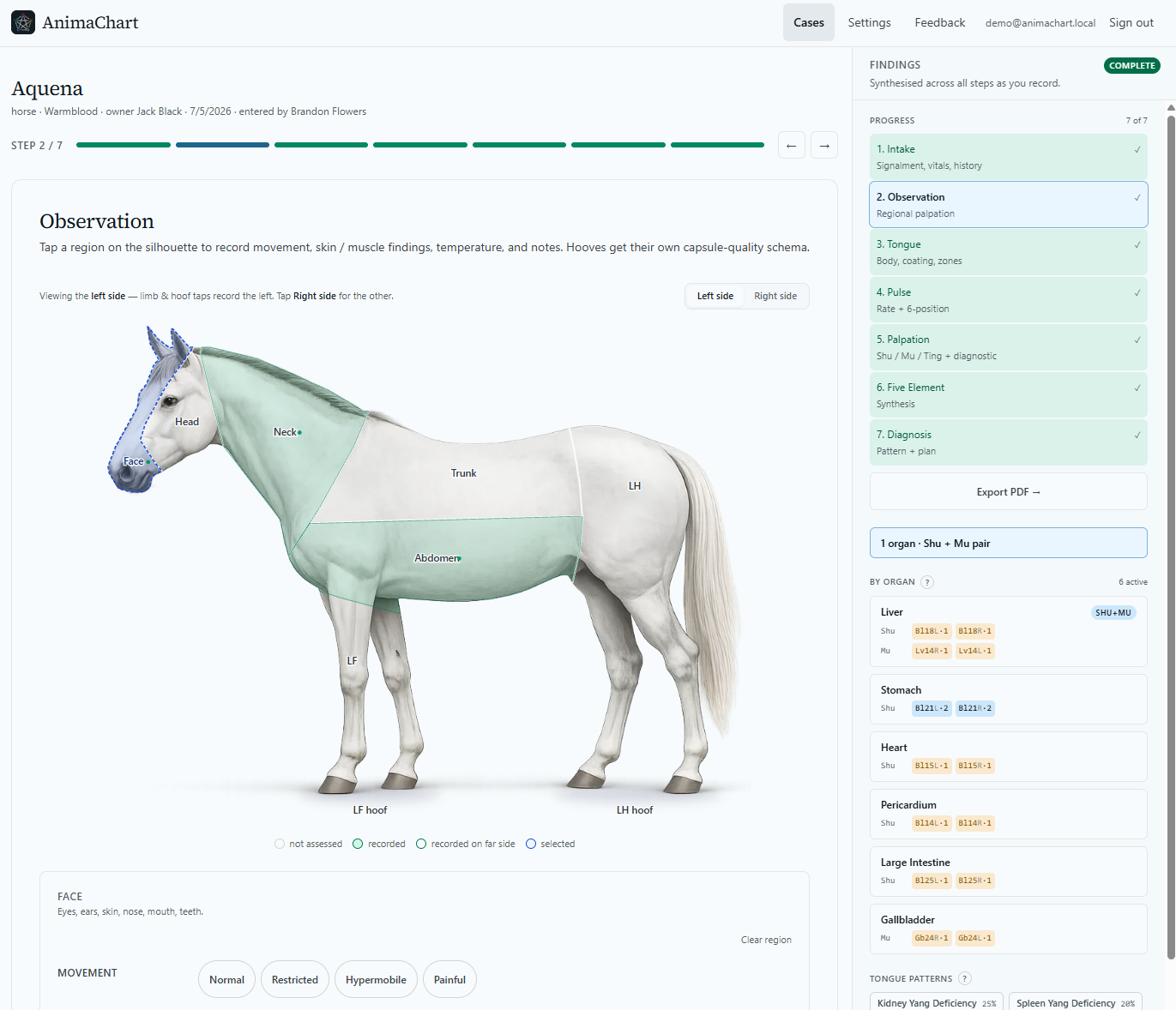
Seven steps that mirror what you actually do: tap the horse, the tongue zones, the pulse positions, the Back-Shu line. Or say it out loud and keep both hands on the horse.
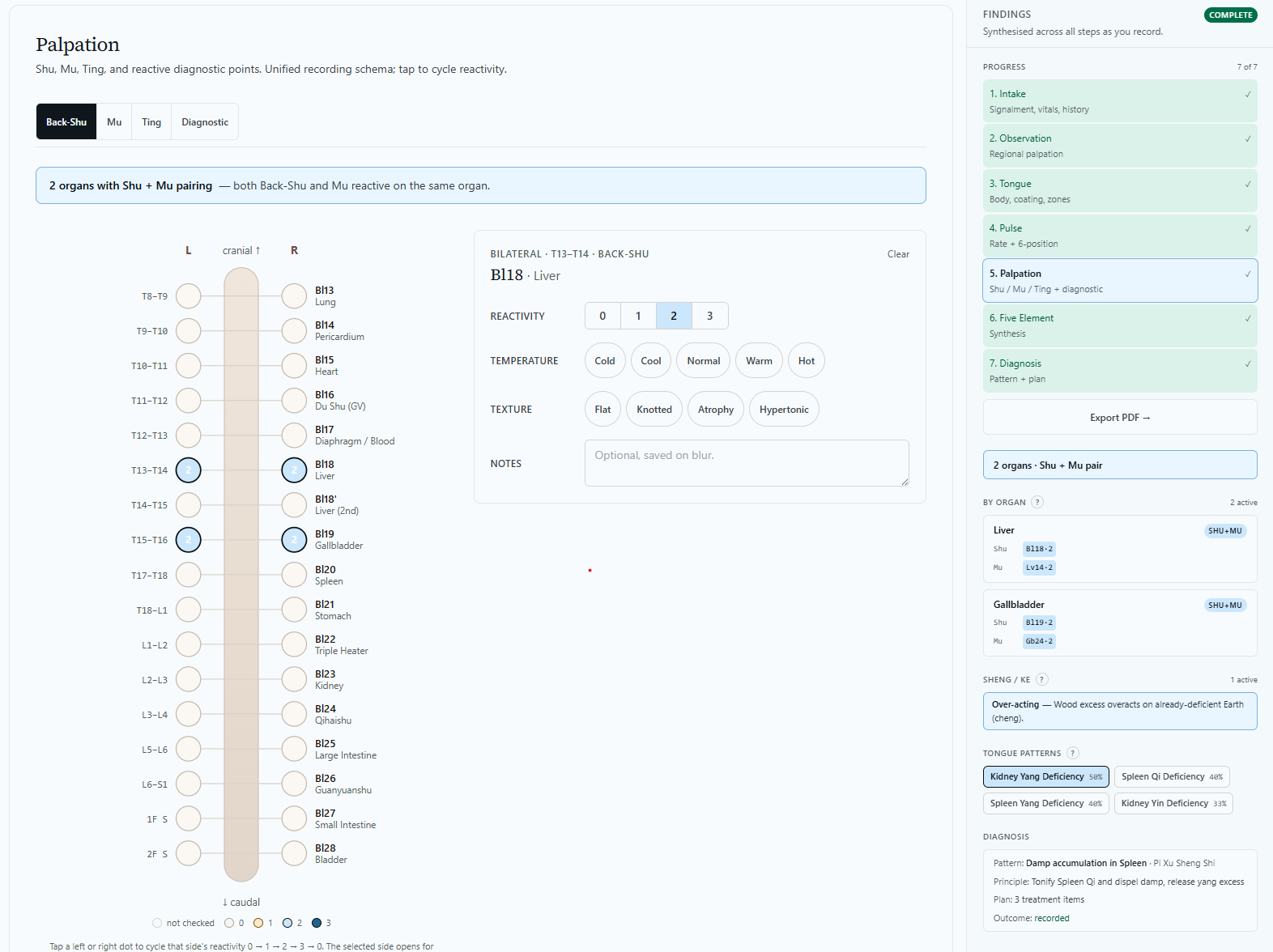
Every entry feeds one live findings panel — per-organ rollups, Shu+Mu+Ting trios, Sheng/Ke disturbances, tongue and pulse patterns. The picture is assembled before you reach the diagnosis.
Optional AI suggestions give a ranked second read of your own findings — yours to verify. Then turn the working diagnosis into an editable point prescription and print the treatment plan.
The exam
Each step captures what you actually examine — nothing more — and every entry feeds the same case. The record fills itself in as you go.
Signalment, vitals, owner complaint, structured history.
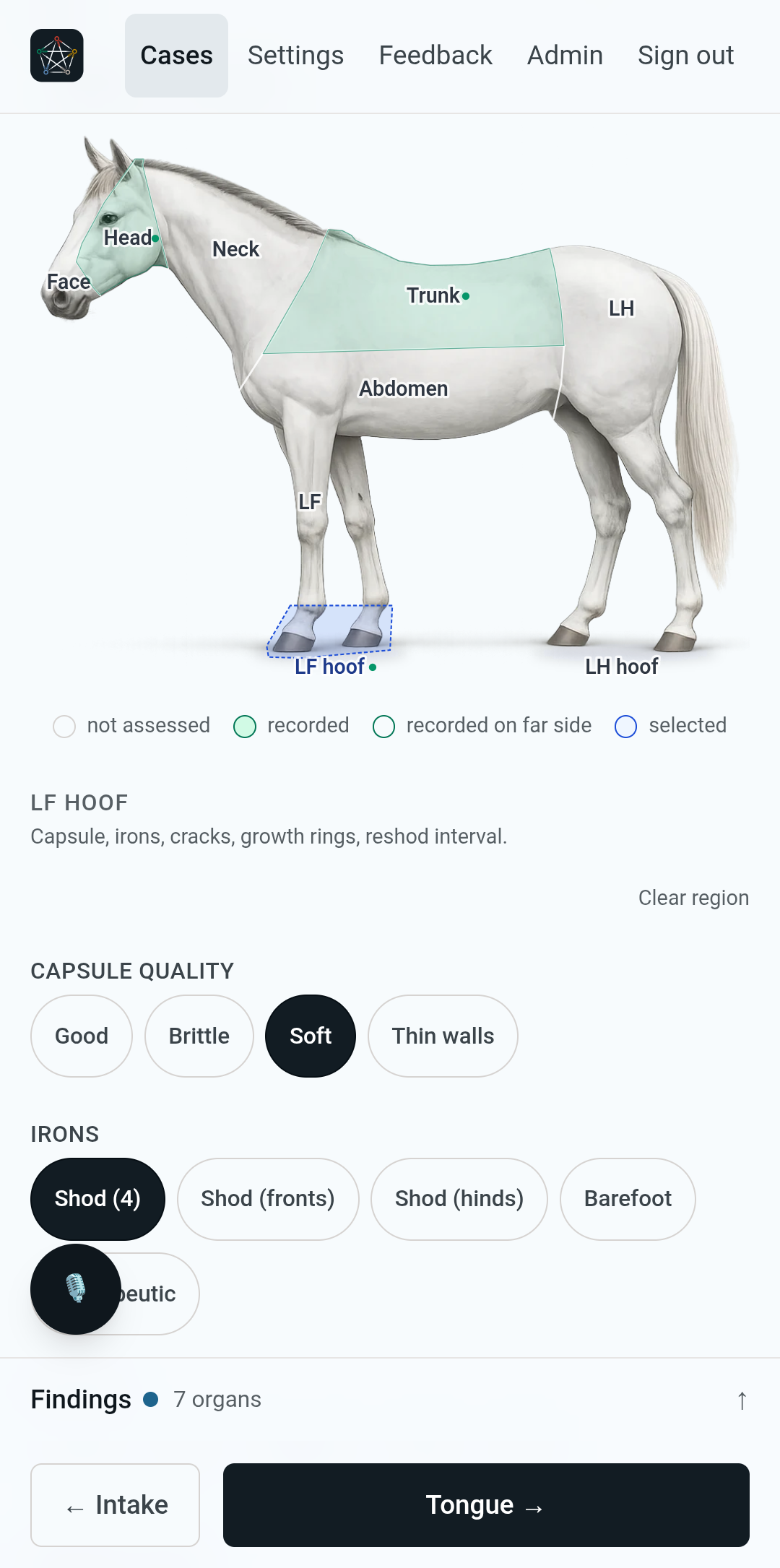
An anatomical horse map with tappable regions — and four hooves.
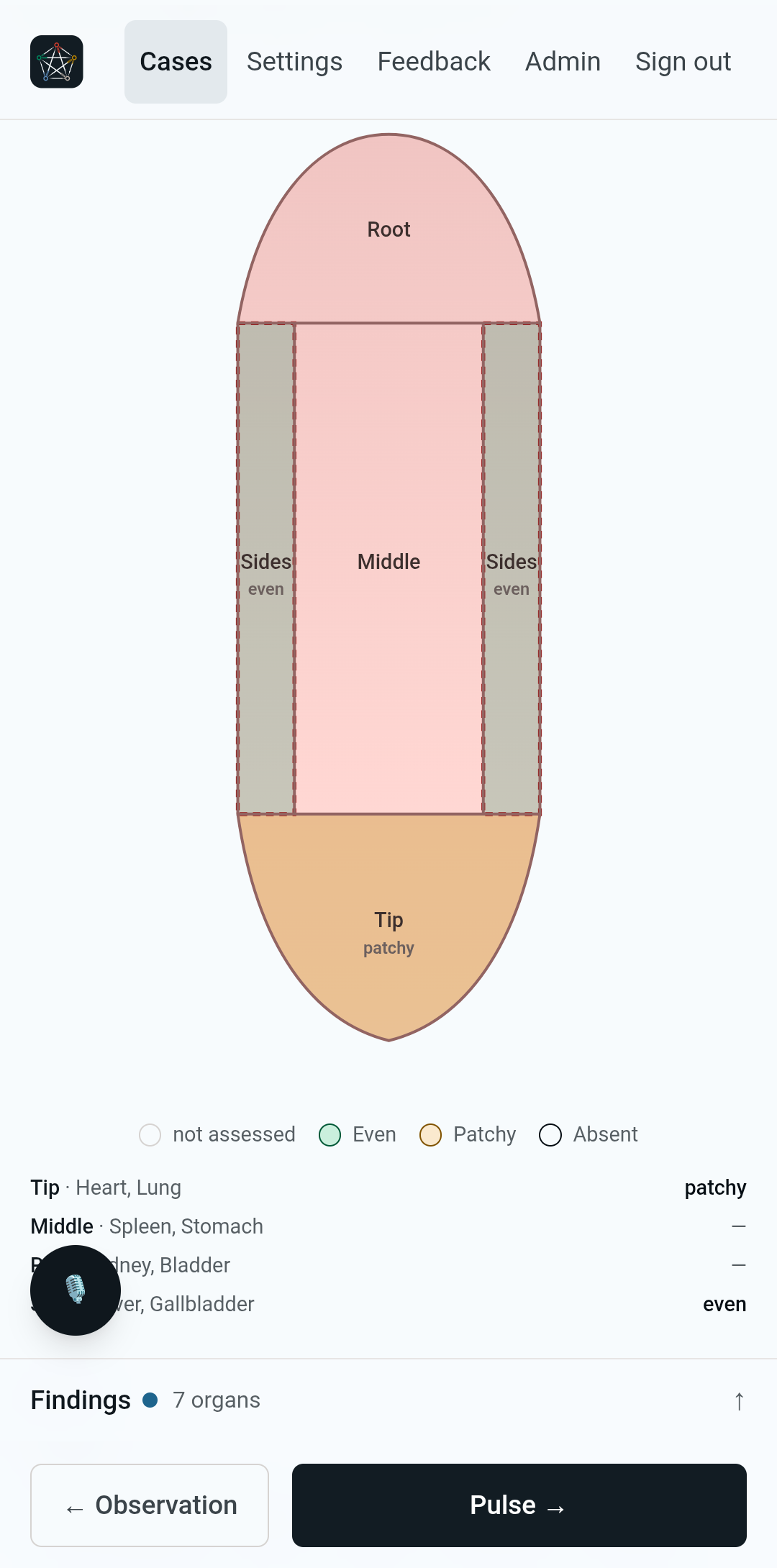
Four-zone map, global qualities, pattern suggestions.
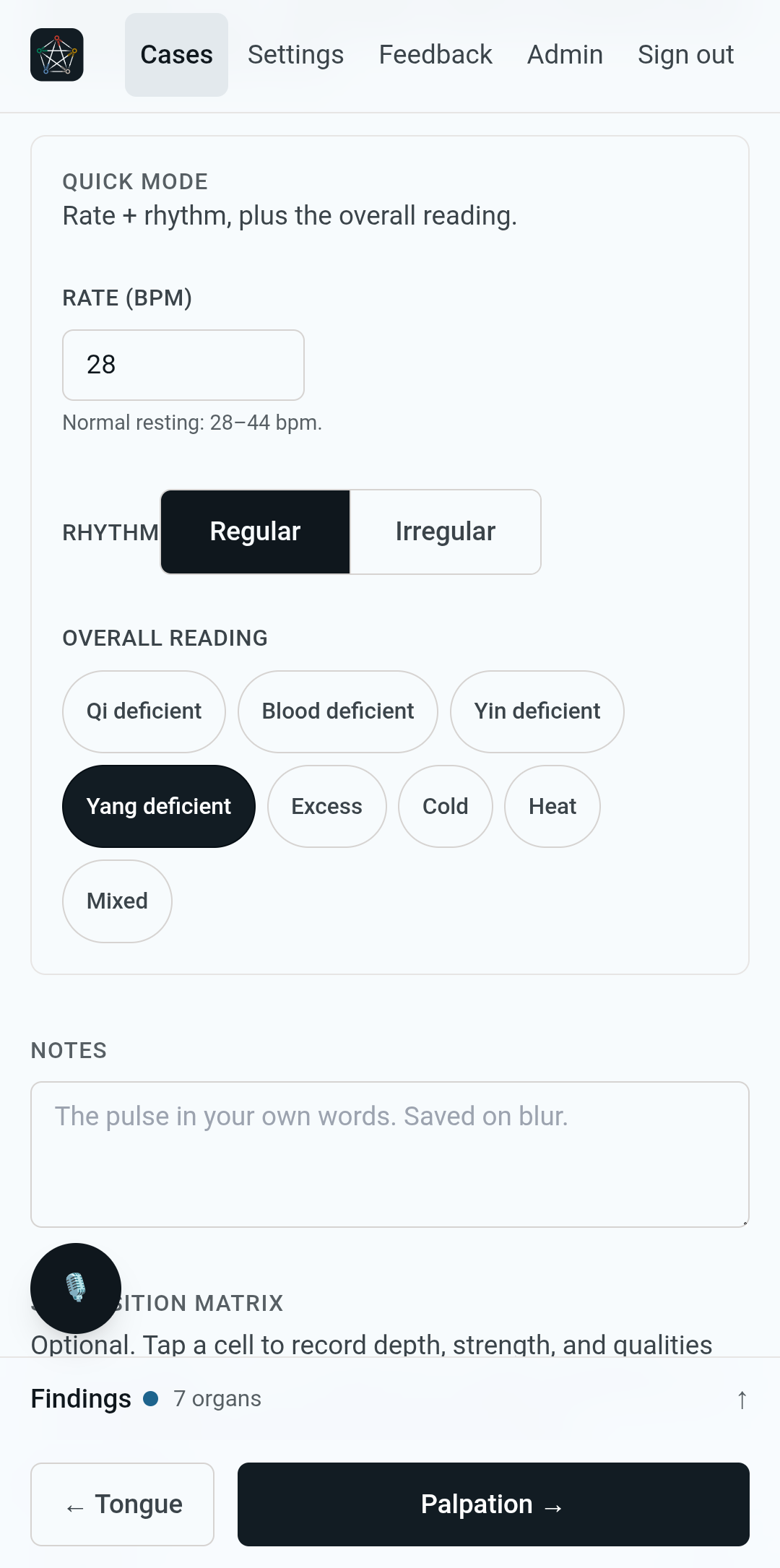
Quick read, or the full six-position matrix with Kidney Yin/Yang.
Back-Shu, Mu, Ting & diagnostic points from the canon graph.
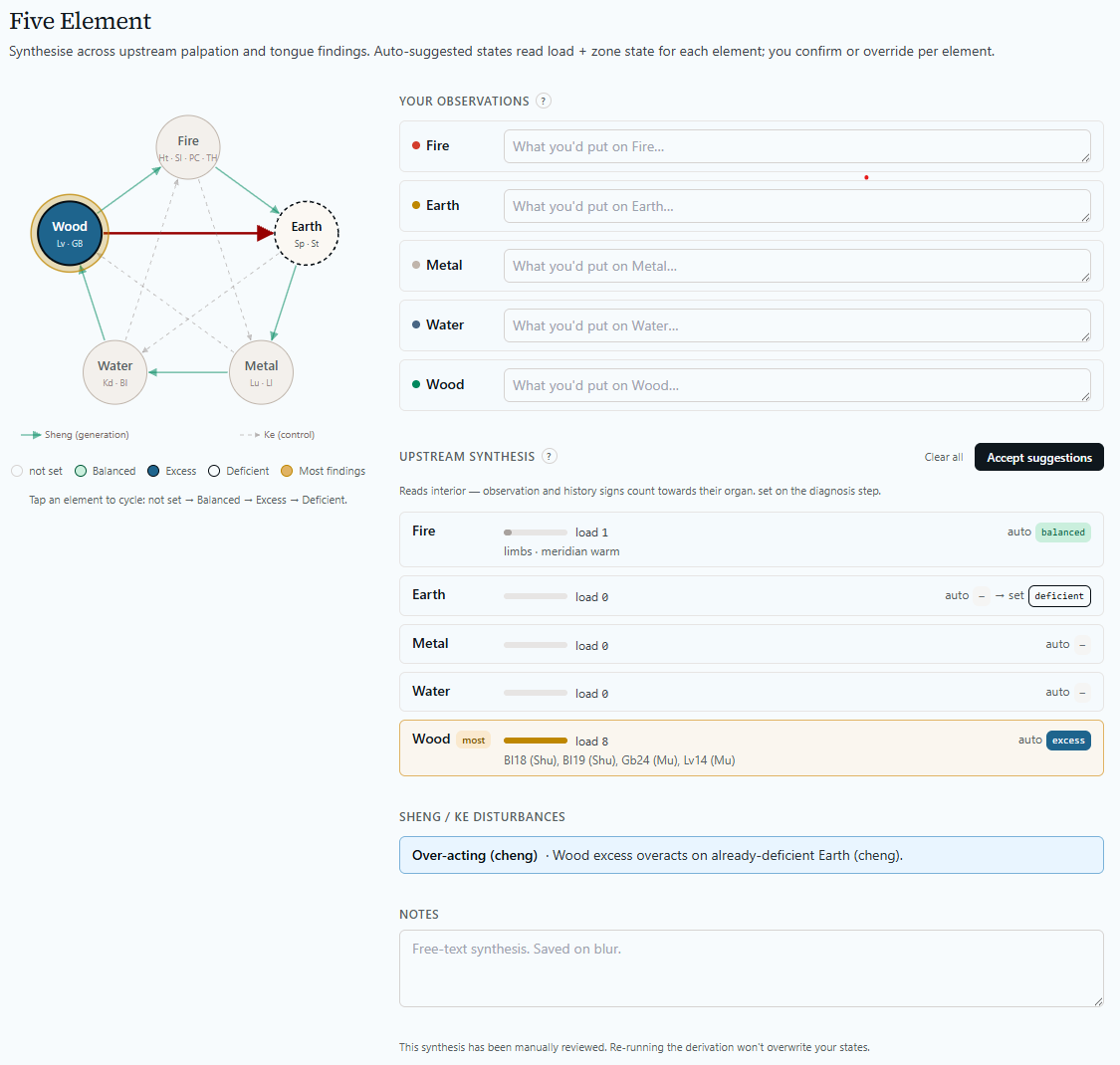
A wheel with a Sheng/Ke disturbance detector.
Eight Principles, Zang-Fu, pattern picker, treatment plan & outcome.
New Hands-free voice
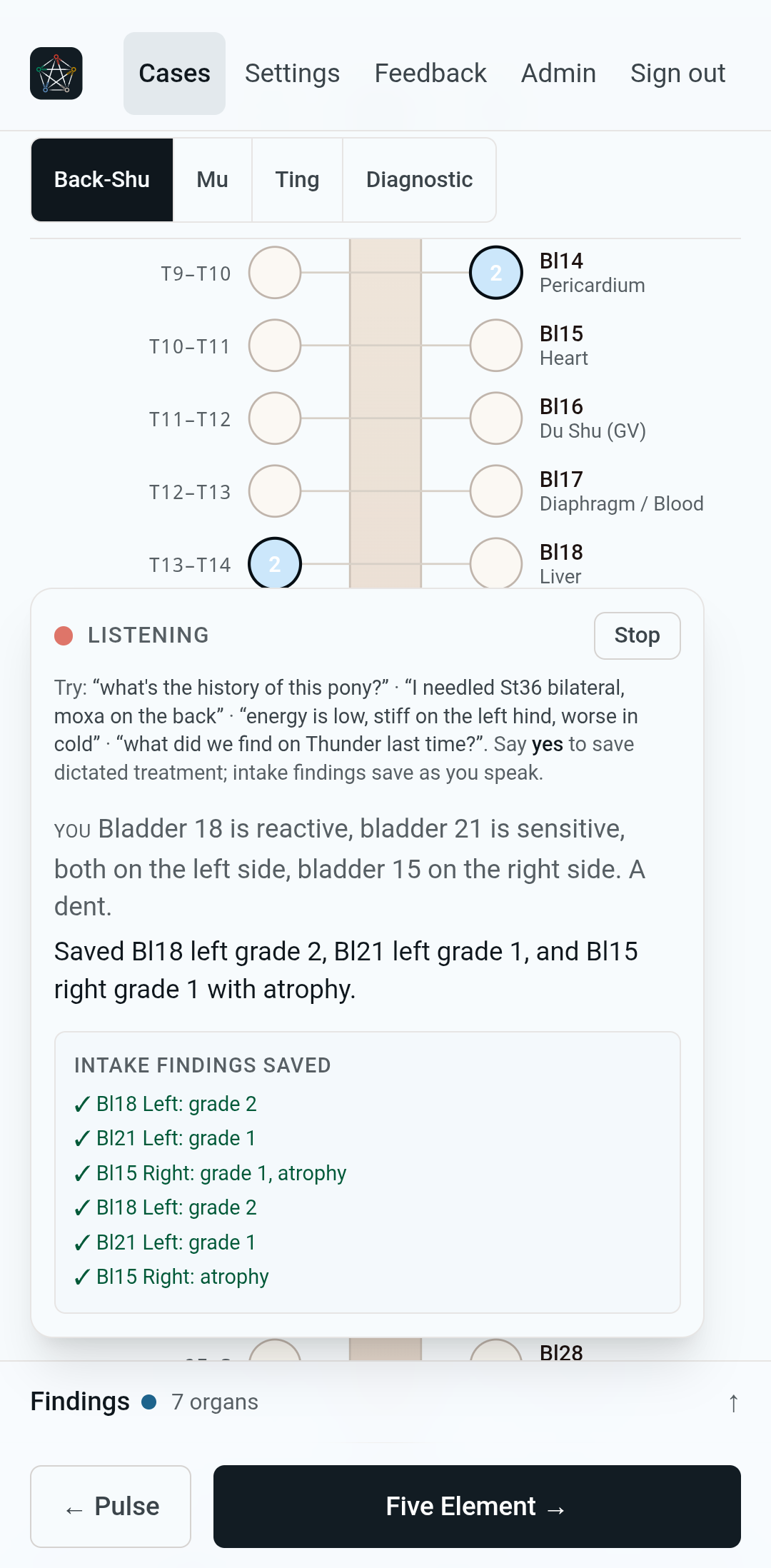
Speak while you examine. The assistant writes what you say into the case's structured fields, reads each finding back for confirmation, and can open a case or pull up a past one without you touching the screen.
Access stays scoped — the assistant only ever reaches cases you could already open yourself. Voice needs a connection.
New AI decision support
One click folds the exam you've charted — intake, tongue, pulse, palpation, five element — into ranked pattern suggestions, each citing the findings behind it. Treat them as a prompt to test your own reasoning against, never as a result: every suggestion belongs to your clinical judgement before it belongs in the record.
Optional and metered transparently, with a monthly allowance. Nothing the model proposes enters the record until you put it there.
Try it on a case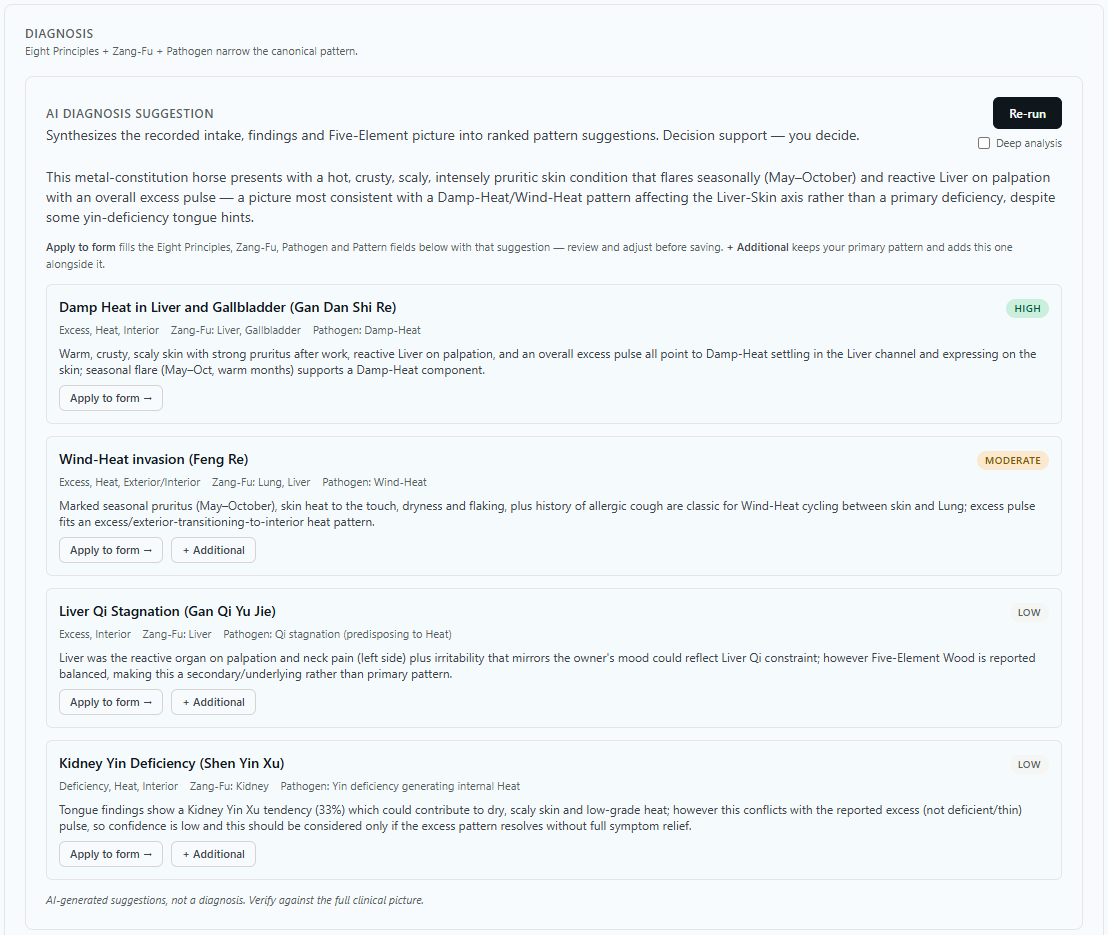
New Works offline
AnimaChart installs like an app and works with no connection. Open a case before you ride out and the whole exam is right there — chart every finding with zero bars, and it syncs itself the moment you're back in range.
Voice and AI need a connection — everything else keeps working without one.
Sync status
Offline — 3 changes saved on this device Syncing 3 offline changes… Offline changes syncedThe core idea
A findings panel follows you through every step and keeps a running synthesis of what you've recorded — no flipping between pages to see where the case stands.
Five-Element reasoning
Tap each element balanced, excess or deficient. AnimaChart reads the whole wheel and flags every disturbed generating and controlling relationship — and proposes a starting position from the palpation, tongue and pulse you already recorded, for you to confirm.
Capture
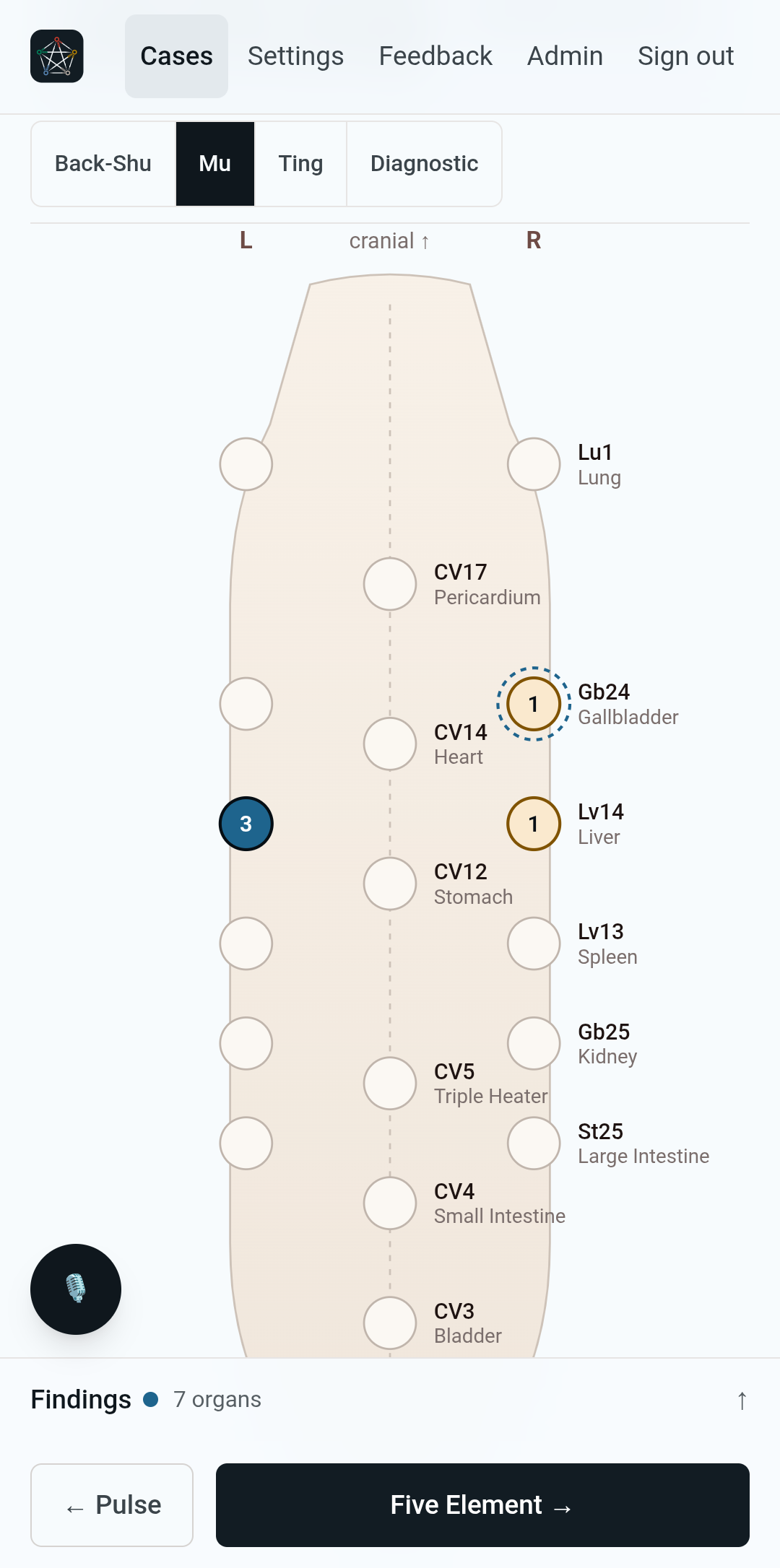
Tap-to-cycle diagrams for each step — so charting stays fast, consistently coded, and legible in the barn.
Who it's for
The body maps, the hoof schema and the point canon follow equine anatomy. Small animals are coming in the near future.
Cool, calm, paper-like surfaces and hairline structure that stay legible in the barn and in direct sunlight.
Sign in, start a case, and chart. Autosave on every field — there are no Save buttons.
Pricing
No subscription and no tiers. You pay for cases when you open them, and the AI is already included.
Your first 3 cases
Free
3 complete case records — every step, the findings panel, voice and AI — before you decide anything. No card to enter.
Every case after that
CHF2per case
€2 · $2 · £2 — charged in your own currency
Buy as many cases as you need, whenever you need them. They don't expire, and nothing renews on its own.
Prices exclude any VAT that applies to you. Payment is handled by Stripe; the exact amount in your currency is shown before you confirm.
Start with 3 free casesThe full case record runs in your browser and installs to your phone. Nothing to set up beyond signing in.
Open AnimaChartapp.animachart.com